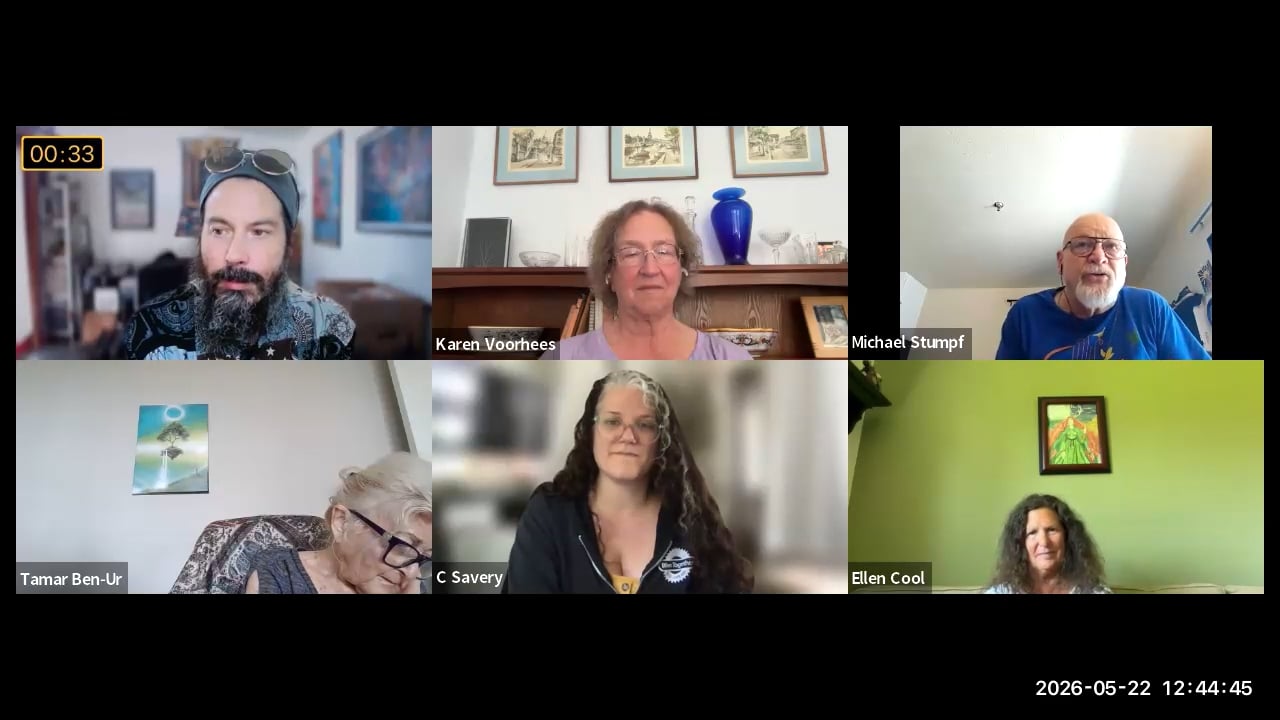
This Friday community meet-up was a workshop and rehearsal for the talk Marco will be giving at ICON 2026 in Denver next week: The Future of Integral Is Cooperative. Rather than deliver it as a lecture, he opened it up—framing a Seven C’s structure and inviting everyone present to take a principle, sit with it for five minutes, and bring something back. What emerged was a genuine co-creation: a mandala assembled in real time by seven people, each contributing a facet of a vision none of them could hold alone. The recording is below. If you want to continue the conversation, or if any of the Seven C’s calls to you, jump in.
Meeting Notes
Community Meet-Up: What If the Future of Integral Is Cooperative? — May 22, 2026
Header
Meeting: Cosmos Community Meet-Up — “What If the Future of Integral Is Cooperative?”
Date: Friday, May 22, 2026, ~12:00–1:10 PM MT
Attendees: Marco V Morelli, Caroline Savery, Ellen Cool, Karen Voorhees, Michael Stumpf, Tamar Ben-Ur, Skylar Cozmos
Recording: Yes
Working Document: N/A (talk outline in development)
Purpose
This session served simultaneously as a Cosmos community meet-up and as a rehearsal and collaborative workshop for Marco’s upcoming ICON 2026 talk, “The Future of Integral Is Cooperative” (24-minute presentation, May 29–31 in Denver). The stated goal was to develop the Seven C’s framework—seven principles of an integral and cooperative future—through live co-creation with community members, with each participant taking ownership of one principle and offering their reflective contribution.
Topics Covered
Framing: The ICON Talk and the Seven C’s
Marco opened by situating the session as a preview of his ICON presentation, which aims to reframe the question of integral’s future through the lens of cooperativism. He proposed that the broader claim—“the future is cooperative”—might stand on its own independent of the “integral” qualifier, and that he intends to produce a downloadable PDF articulating these principles for wider distribution.
He proposed a participatory structure: name seven C’s as principles of an integral/cooperative future, have each participant claim one and spend five minutes with it, then reconvene to assemble a “mandala” of collective vision.
Marco’s Personal Lineage: From Integral Institute to Cosmos
Before naming the principles, Marco briefly traced his own path—arriving in Colorado 23 years ago, working with Ken Wilber and the Integral Institute during its seminal 2000–2007 phase, witnessing both the catalytic convergence and the subsequent diaspora, and carrying lessons from that experiment into the founding of Cosmos Cooperative. He identified structural contradictions in the early II model—around power distribution, founder-community dynamics, economic assumptions, and the state of technology—as formative influences on what Cosmos is trying to do differently.
The Seven C’s: Principle by Principle
Seven participants each took one principle and offered a two-minute reflection in the first round:
1. Complexity — Caroline Savery
Drawing on her work in cooperative development and her “Fractal Praxis” framework, Caroline argued that life naturally increases complexity when left to its own devices—through perturbation, adaptation, and the emergence of higher-order structures. The crisis in contemporary society, she said, is a crisis of complexity-tolerance: reductionism—the artificial flattening of complexity into boxes—creates harm by misrepresenting reality. A regenerative culture requires people trained in cognitive and social labor: holding paradox, tolerating tension, and loving each other across difference. This is the precondition for what she called “a theory of everybody”—Marco’s original animating idea for Cosmos.
2. Care — Marco V Morelli
Care, Marco offered, is how we know we’re alive. The present economy rewards its opposite—the shutdown of attention, the exclusion of beings who inconvenience a system. In an integral and cooperative future, care will not be a side concern; it will be recognized, valued, and compensated throughout the full life cycle—from youth through productive life through elderhood. He connected this directly to Cosmos’s aspiration to embody in its own structure what it hopes to see reflected in the broader society.
3. Consciousness — Michael Stumpf
Michael described consciousness as “the ultimate mystery of complexity and care”—rough and tumble, not easy, but capable of flow, like learning to surf. He held up a quilt of three dolphins as a visual metaphor (his cousin made it for his 70th birthday), invoking the idea that just as dolphins are creatures of ocean and biosphere, humans are creatures of consciousness and relational field. He referenced The Undreamed Self and arrived at Jean Gebser’s “ever-present origin” as a touchstone for the non-temporal dimension of consciousness.
4. Creativity — Karen Voorhees
Creativity, Karen said, is the divine in us—the transcendent expressing itself through form. She traced an arc from the Big Bang through plate tectonics through biological life to the prefrontal cortex’s pattern-making to the stories we tell each other. She evoked the “spore” metaphor: the integral diaspora from the Integral Institute, now maturing into stable, sustainable institutions that are connecting into a “global synaptic network.” Creativity, she concluded, is not optional—it is the drive that will outperform regression every time it has to rebuild.
5. Community — Tamar Ben-Ur
Tamar offered two images: the home (a place of safety and support) and the womb (a place where everything is held, encouraged, nourished before it emerges). Most problems in contemporary community, she argued, stem from fear—and fear causes regression to earlier developmental stages. Safety is the precondition for everything else: creativity, complexity, consciousness cannot develop without it. She noted resonances with Otto Scharmer’s work without having named it explicitly in the session.
6. Commons — Skylar Cozmos
The commons, Skylar Cozmos reflected, is the antidote to a culture of individual ownership and competitive accumulation. It means shared stewardship of tools, materials, and knowledge—oriented toward durability and repairability rather than extraction. Crucially, the commons extends to nature itself: we are part of nature, not separate from it, and the commons is the relational form in which we remember that.
7. Cosmos — Ellen Cool
Ellen offered a free-expressionist invocation: the mystery, the answers, everything seen and unseen, infinite possibilities, a primordial faith in the ever-present origin. Yin and yang—polarized similarities opposite in presentation, all part of the whole. “Creating, mutating, composting, returning, birthing, resurrecting, dying, repeating. All gelled together in a slimy mess called life.”
Integration Round (Reverse Order)
In a second round (7→1), participants reflected on what the whole meant rather than their individual piece:
- Ellen: It’s circular—Cosmos spirals back to Complexity; the seven C’s aren’t a list, they’re a topology. Cosmos Co-op is doing this work in real time, in three dimensions.
- Skylar Cozmos: Commons was hard to isolate from Community—they’re already integrated. The practical implication is distributing resources where they’re best leveraged.
- Tamar: Visualized the Seven C’s as a pyramid—Community, Care, and Commons form the base; Complexity, Creativity, and Consciousness rise from it; Cosmos (context) receives everything at the summit. Suggested that whatever is created from this framework—art, writing, practice—expresses all seven at once.
- Karen: Gratitude. The universe has been doing this for 13.82 billion years. What’s new—what’s distinctly human—is intentionality. As we approach coherence, we become “conscious co-creators with the divine plan.” The question is how much beauty and complexity becomes possible.
- Tamar (interjection): Proposed conscience as an implicit eighth principle—consciousness can move in multiple directions; conscience is the orientation toward good.
- Michael: The eight principles form something like an infinity symbol standing vertically—holding the tension between cooperation and competition, the individual and the collective, time and the ever-present origin.
- Marco: Returned to his 2016 essay “Integral in Me” and a Bonhoeffer quote Terry Patton had introduced him to: “The person who loves their dream of community will destroy community. But the person who loves those around them will create community.” This, Marco said, is the fulcrum—the difference between an ideology of cooperation and its living enactment.
- Caroline: Named Cooperation itself as a missing C—the praxis beneath all the others. Cooperativism is how we care for each other, steward the commons, enable creative expression, build the community. And for it to work, there must be a myth of belonging: a cosmology in which we actually all belong together and none of us need to be annihilated.
Competition, Succession, and the Mythopoetic Horizon
The session closed with a threading of cooperation and competition—Michael noting that healthy competition operates within and because of cooperation (no organized sport exists without it), and that the “deficient myth of the gladiator” is beginning to give way. Marco: “We’re betting that cooperativism is going to out-compete.” Caroline, in the chat: “May the best selves / best ideas succeed!”—foregrounding “succeed” as ecological succession, not zero-sum winning.
Karen’s closing image: “We’re hospicing the outgoing world order while midwifing the incoming one.” Caroline and Karen ended the session with an explicit commitment to collaborate on Cosmos myth-making: “We need to tell stories that will grab people by the lapels.”
Action Items
| Who | Item |
|---|---|
| Marco | Distill the Seven C’s framework into a short downloadable essay / PDF for the Cosmos website |
| Marco | Condense the session into the 24-minute ICON talk format (May 29, Denver) |
| Marco | Bring a meditation bell to ICON for the live version of this exercise |
| Caroline + Karen | Begin collaboration on Cosmos myth-making / narrative development (post-ICON) |
Decisions Made
- The Seven C’s framework (Complexity, Care, Consciousness, Creativity, Community, Commons, Cosmos) will form the structural spine of Marco’s ICON 2026 talk.
- Cooperation (proposed by Caroline) will be considered as an eighth C, potentially for future iterations of the talk or the downloadable essay.
- The participatory exercise structure—assign one principle per person, five-minute reflection, reassemble—will be adapted for the live ICON session using small breakout circles.
Open Questions
- Should the framework be “Seven C’s” or expand to eight (with Cooperation or Conscience)?
- What is the right framing for the downloadable PDF—marketing (“seven key principles…”) vs. invitation vs. manifesto?
- How does Cosmos as an organization appear in the talk—as case study, as example, as invitation to join?
- What is the ongoing vehicle for myth-making collaboration between Caroline, Karen, and others interested in this?
Narrative Summary
On Friday, May 22nd, a week before the ICON conference opened in Denver, seven Cosmos community members gathered online for what Marco described as “loose”—and what turned out to be something richer than rehearsal.
The session was structured around a framework Marco has been developing for his ICON talk: seven principles of an integral and cooperative future, each beginning with the letter C. Rather than present the framework as finished, he handed it over—literally. Each participant claimed a principle, sat with it in silence for five minutes, and came back with whatever had arisen: a riff, an image, a conviction, a poem fragment. The instruction was as open as the question: “a dance would be fine.”
What they assembled, round by round, was less a list than a mandala—each piece distinct, each essential, each revealing something that no other angle could. Caroline Savery took Complexity and delivered a precision argument about how life’s self-organizing drive becomes, in human society, a demand for cognitive and social training: the capacity to hold paradox without collapsing it. Marco took Care and located it at the threshold of aliveness—the thing that distinguishes a person from inert matter, and that an economy organized around its opposite can only impoverish. Michael Stumpf held Consciousness lightly, invoking dolphins, a quilt, a Tibetan text, and finally Jean Gebser’s “ever-present origin”—the place where all of it converges before it disperses into time. Karen Voorhees took Creativity and traced it from the Big Bang to the prefrontal cortex to the maturing “spores” of a diaspora that once came out of a crucible in Boulder, now quietly building institutions that can last. Tamar Ben-Ur brought Community back to its pre-conditions—safety, the womb, the home—and reminded the room that fear is what shrinks people back; without shelter, nothing grows. Skylar Cozmos offered Commons as the memory that we are part of nature, not its owners, and that the culture of individual accumulation is something we can decide, collectively, not to repeat. Ellen Cool closed with Cosmos—invocatory, incantatory, refusing the reduction: “creating, mutating, composting, returning, birthing, resurrecting, dying, repeating—all gelled together in a slimy mess called life.”
In the integration round, something became visible that hadn’t been stated directly: the seven principles aren’t sequential. They’re recursive. Ellen saw it immediately—Cosmos spirals back to Complexity; everything is inside everything else. Tamar saw a pyramid. Michael saw an infinity symbol standing upright. Marco reached for Dietrich Bonhoeffer, via Terry Patton, for the one line that holds the whole together: “The person who loves their dream of community will destroy community. But the person who loves those around them will create community.” The difference between an ideology of cooperation and its enactment is not a principle. It’s a practice of turning toward the person in front of you.
Caroline added the missing C at the end—not as a correction but as a recognition: Cooperation is the praxis that runs beneath all seven. And for cooperation to work at scale, she argued, you need a myth: a story in which we all belong here, none of us need be annihilated, and the work we’re doing together is worth doing. Karen named it differently but said the same thing: “We need to tell stories that will grab people by the lapels.”
By the time Ellen said goodbye—“great rehearsal, Marco, see you Wednesday”—the session had become the thing it was trying to describe: a field in which each person’s contribution made room for the others, and what emerged was more than any of them had arrived with.
Marco’s ICON 2026 talk, “The Future of Integral Is Cooperative,” takes place Friday, May 30th in Denver. Cosmos will have a presence throughout the conference (May 29–31) in the Liminal Lounge and elsewhere. If you’re attending, find us there. If you’re not, we’ll share recordings and notes afterward.