Cosmos Cafe “Constraints in Creative & Community Life” taking place 2pm MT on Wednesday August 19th @ http://cosmos.coop/zoom/community
Exploring the Positive Effects of Constraints
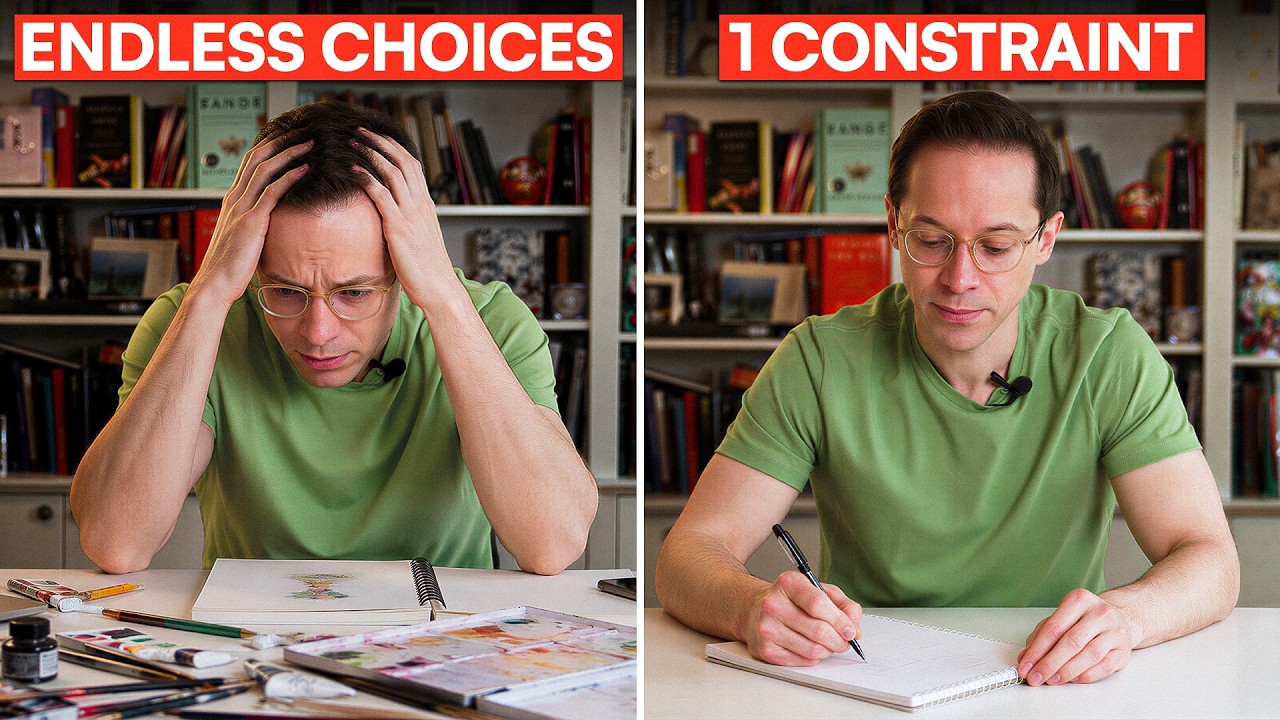
Please start by taking in the above 25 minute video.
 I am proposing a Cosmos Cafe themed on Constraints in Creative Life & Social Action: How we relate to or use CONSTRAINTS in our personal creative processes—and how they could be deployed within Cosmos Co-op in beneficial ways.
I think the results of this discussion could be one of the most important cultural conversations to take place in Cosmos. …Especially as it pertains to our organizational strategy and the risks incumbent to fostering a sprawling, uncoordinated operations based on wanting to say “yes” to everything.
My analysis on Cosmos Co-op’s lack of a “constraints culture”
Generosity and spirited engagement gets us FAR—it has gotten us to where we are in this moment, which is actually quite a lot of accomplishment. But: what if we could have gone further with the same resources, if we embraced design-by-constraint?
As it is right now, we’re operating now on a culture of salience: doing what seems to need to be done. And a lot IS getting done, but it’s not coordinated effectively across silos (by silos, I inclusively mean: individuals and their particular operating lanes/talents). It’s non-linear, and it’s uncoordinated. People are working in their lanes and getting shit done, not necessarily transparent to each other. It gives off that pluralistic vibe that’s core to Cosmos’ aesthetic: creators creating, unhindered. We’re all organizational co-creators (those of us who manage to navigate the often-non-intuitive structure here)… but are we acting on one coherent vision expressed divergently? Or are our visions actually pulling us in numerous different directions?
I believe one of Cosmos’ biggest design-scale mistakes right now is trying to do too much.
It’s a fractal occurring at many scales.
And this is cultural. It derives from culture, and from habit too.
Our culture is one of following where visions lead, and generative collaborations guide. It is not pre-figured by much—certainly not by rules, restrictions, constraints.
But this cultural inclination, if left unchecked, has the potential to ruin our grand efforts—just like General Magic failed spectacularly, in contrast to its constraints-oriented counterparts like the Palm Pilot (see minutes 2-4 in the video)
When we’re not disciplined by constraints, either in precise language or in pruned-back path-setting, we deal with mission drift. A hundred strategies, and surely a million tactics, could be used to fulfill on a vague ideal… on a promise that’s vastly open to interpretation. The vagueness might feel like it protects inclusiveness and invites dialogue. But the possible interpretations and results and conversations become combinatorially explosive. Whereas: the greater the specificity of what it is we are really committed to doing, transforms the results, by orders of magnitude.
I get it—it’s painful to let go of the “what ifs” and "imagine…!"s. And it’s painful to deliberate and put in the effort to reach rigorous clarity, before just “winging it.”
Especially because: This is truly in our nature as creators!
Of course it’s natural for artists to tend to want to do more than they have the capacity to do—that’s in the nature/spirit of being creative itself—going outside the bounds.
As creators, we want to say “yes” to everything that sparks our hearts alive.
As creators we tend to be scrappy, and make something grand out of minimal inputs.
As creators we love the challenge of “let’s figure it out as we go.”
But if we don’t kill most of our creative babies early on in the process, we almost never arrive at any viable fully-formed creative offering to put out in the world. Anyone here who’s put years into their creative process, gets this.
Adopting Constraint-Based Design — and Adapting, Too
How might “getting good a constraints” look in the organization? Here are some thoughts—3 major ones, and some more minor reflections:
1. Insisting on structure. Regular reporting—internally among working teams AND regular communications to members. Data-based decision-making. Participatory pathways, supported by the platform’s design. Synching up as a full team through special meetings. Knowing who is accountable to who. Constraining department funding to revenue results.
These are all ways structure manifests, and tbh we’re not doing great at ANY of this thus far… it’s the kind of thing we tend to overlook and leave off of our meetings, in favor of the expansive/possibilities-oriented discussion. We need to hire more operators if we want to remain purely creative actors… or, bring more structure-minded people onto our leadership & Council teams to counterbalance our tendencies.
2. The Council Functions to Constrain Options. Operational teams (Circles) define what they want to achieve; the Council, which exists to defend the life of the organization, ought to define the constraints. This role should be respected and honored.
Rather than the Circles saying “Here’s what we want to spend money on and do” and social/cultural norms implying that Council should respond with just “go ahead”; instead, the Council would retort with something like: “Well, here’s the budget we’ve allocated you: let’s see what you can do with it.”
This structural choice would force each Circle to really defend what it is that they’re doing, and to go back to the drawing board as needed. They’d be more careful about what outcomes & results they’re aiming for. They’d be very clear about the “theory of change”—why their Circle is absolutely essential to achieving impacts for Cosmos’ mission & membership. They’d build off of successes, rather than completely reinventing.
This kind of “point - counterpoint” can be highly generative in a musical arrangement. It doesn’t have to be adversarial. Indeed, culturally speaking, we must hold the role of saying “no” and implementing constraints with great reverence. The Council could play this sacred role, in counterpoint to the Synergy Circle (sum of all operational Circles).
Right now, this isn’t the case in part because the Council consists of the same people as the Synergy Circle. This MUST shift as we scale.
What if Council, steward of the whole, embraced things like:
- We restricted ourselves to ONLY resolving bugs/issues of the user experience, or ONLY ensuring we’re at breakeven revenues through marketing efforts—BEFORE more money would be unlocked to be spent on building out any other potentials?
- What if we actually attached org-wide constraints to the performance of specific Circles—thus making all Circles & participants invested in any given Circle’s success?
In my observation, we operate sometimes on trust for the founders and the way the founders have done things. I think this stems from deep respect for the visionary minds/co-creative process involved here. But when we’re reluctant to hold people accountable to objective, not narrative and emotional results, the whole thing can suffer.
3. The Small Teams Principle, described around minute 12 in the video. Pixar: Story development happens in small teams for a long time: iterate, get feedback, improve it, as many times as you need to—because the ideation phase is cheap. It gets expensive once it gets committed to production.
- Our Circles should spend a lot more time in ideation and development of plans & projects that could serve this co-op. They should gather feedback from fellow members and stakeholders with different perspectives—repeatedly. And only once those ideas have built significant buy-in, should company resources (HR, funding, time/energy, etc.) be applied to them.
- So for example: in coming up with designs for what a partcipatory online platform could look like, why not source that from a slew of small teams with diverse/divergent ideas? Then those teams compete with their IDEAS for the limited resources to “go into production.”
- If Cosmos had decent collaboration & gathering spaces built into our platform, we could create the feeling of like R&D labs that were fun to participate in. Where your membership invites you to become a real stakeholder in the ideation of Cosmos, and critiquing the ideas out there so they get better. And it’s fun to play there in the sandbox! And it’s also fun to bring your team’s work to “competition”—to claim some amount of the scarce resources available each period within this iterative, participant-driven platform. I think this will drive the cultural behavior of being really inclined to tighten, sharpen & refine your ideas and the human-centered design therein—and that this work is actually a kind of service to the entire membership! In this model, high performance, and not personality or social clout, will get rewarded.
4. Working Backwards - describe the intended outcome in such a way that it can fit on one page. The press release, the box the product gets shipped in, or the news cover story about this organization or product set 10 years in the future. Then, plan backwards how you’ll end up there. I’ve seen this activity really serve crucial conversations when working with start-up co-ops throughout my career.
5. “Best ideas are not first ideas” is an important principle as well. How do we embrace the “pitch 3 ideas, not 1” in our processes?
These are some ways Cosmos might adopt the principle of constraints—and adapt.
Community implications
I’m targeting this conversation about cultural issues & effects I deal with as chief executive organizer in Cosmos’ operations—but I believe cultural questions of “how do we deal with and respond to constraints?” is something EVERY CREATIVE PARTICIPANT in Cosmos probably grapples with personally and socially, too.
The video creator highlights that this is a generalized pattern, across multiple domains and disciplines. So if we really want to unlock the individual genius as well as the collective genius through this platform co-op/community, we’re going to have to get better at CONSTRAINTS.
There will come a point in our org development process where narrative-based aspirational claims will not be enough to sustain growth—even as an explicitly visionary organization. Instead, traction will. Achievement of tangible goals will.
I want to show our community of early believers, members, and community who are “bought in” at various levels traction for Cosmos Co-op. I want to publish a glossy, lush annual report this year. I want to win our first $10K referred client. I want to get a dozen more members next month. I want there to be more than zero, more like 5 Cosmos Cafes on the calendar every month.
I want measurable results, that we can all benefit from. To get there, though, we’d need a culture that valued results and by implication, accountability. Then again, it’s impossible to be accountable to a vague mission. We must specify who we really are, and what we’re really here to do, and make that the center of our identity and presentation to the rest of the world. If we don’t cohere on the narrative, and the deliverables, within five weeks from now (when we hold our retreat and first investor invitation meeting): we’ll have to pause/scale back some of our operations at Cosmos Co-op. So indeed—all our good work so far is at stake.
I don’t believe we’ll be able to scale without doing this deep reflection and re-organizing.
I invite us to schedule a synchronous Cafe—and proceed with asynchronous online discussion here. Please comment below with your thoughts, reflections, analysis, etc.!


 Hope you can participate in the Cafe.

 Laughing,Crying,& Dancing Into- Through

