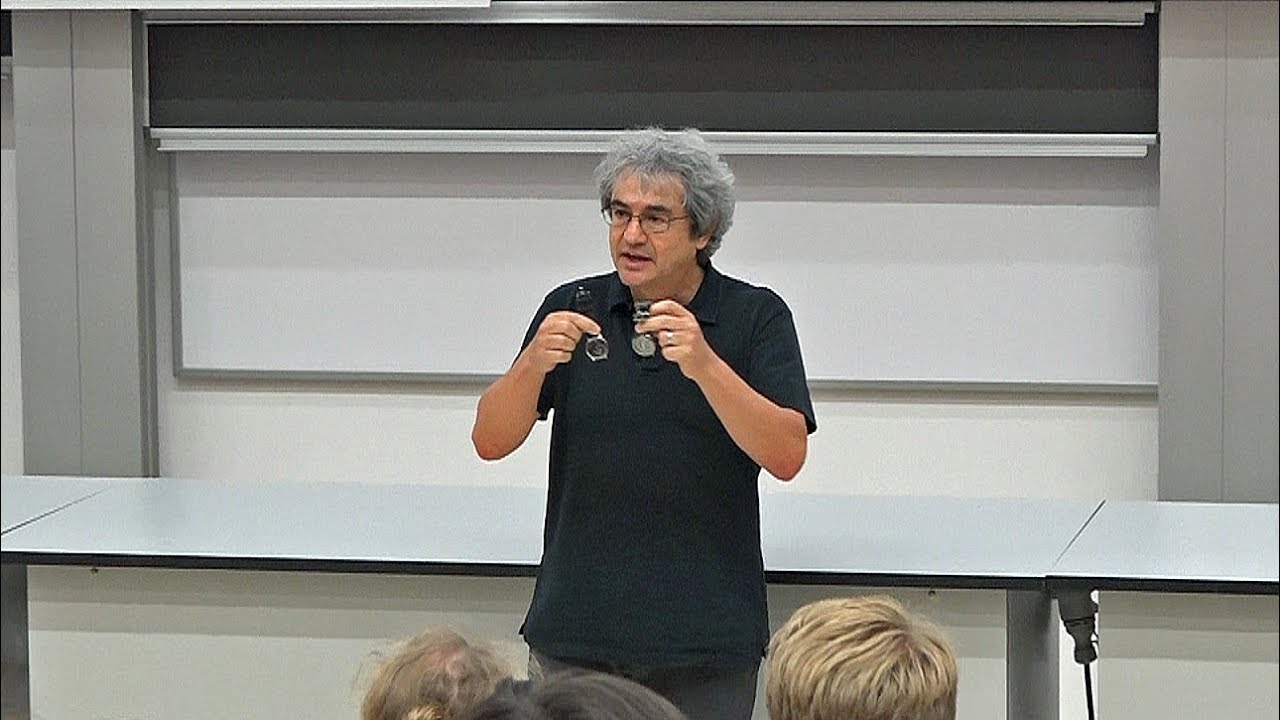
I came across the work of Carlo Rovelli recently and started to delve into the background behind his ideas in order to understand them better. That took me on a rather roundabout path - I ended up reading one of his books for the layperson about time (Reality is Not What It Seems - The Journey to Quantum Gravity) and a good chunk of his textbook on Loop Quantum Gravity (Quantum Gravity) - the latter not for the lay person - and I have been circulating around his most recent book, The Order of Time, but have not actually purchased it (I am trying to keep my book purchases down to a ‘reasonable’ level). There is also this particularly good lecture he gave on the subject (see below) - he is a very good pedagogue. I know this because I understood the main argument of the first chapter of his textbook and I’m pretty sure this was primarily the result of good writing.
I also reviewed the conversation held here on Synchronicity and Modeling Time. I was going to append these ideas to that conversation, but I think these are sufficiently general to justify a separate thread. This is also related to the Rosen paper on the relation between Taoism and Quantum Gravity, which I likewise “read” - well, not completely, I read the first half and the bit about string theory, which I also have some background in, but I skipped the details of his particular approach.
Here are my notes extracted from my readings and listenings of Rovelli’s ideas. It should be noted that Rovelli is one of the leading physicists in the world, having made major contributions to the development of Loop Quantum Gravity which is the primary focus of these documents. Loop Quantum Gravity is a different approach that that of string theory which Rosen uses as his reference in his paper.
- Rovelli makes the argument that within the emerging theories of Quantum Gravity, time as a variable has disappeared. He points out that this has been true for some time (since the late 1960s with the emergence of the Wheeler-DeWitt equation), but that, at first, the significance of this was not understood. In both Quantum Mechanics and General Relativity, time variables are present, but when the two are combined, the time variable disappears. In the emergent understanding of modern physics, time appears to be, uh, irrelevant, although there is still controversy around this idea (Rovelli addresses this in the clip above). The argument Rovelli makes is that the idea of time as an independent variable was first introduced by Newton as a convenient reference to understand how variables relate to each other, and that clocks embody the concept. However, clocks themselves are merely physical systems which vary themselves in a broad variety of ways and the new unification focuses on the relation between processes and systems rather than between processes and any external time variable.
- There is no well-defined present, no shared present - each entity (physical system) has its own (proper) time and these are never comparable (whether the comparison is made with clocks or bodies or something else). Rovelli makes an extended explanation of this in the talk I cited above which I find compelling but I’m not sure everyone will. He does make the point, however, that this is scientific consensus, that there are no real dissenters to this point of view.
- The so-called flow of time from future to past seems to be a product of the interactions between the brain as a memory system and the world - there are indications that outside this relationship, time does not flow. This dovetails with ideas such as Whitehead’s process philosophy. Rovelli is careful to point out that this is his own hypothesis, but that it is consistent with what is accepted knowledge among scientists. It is also a very interesting idea.
- Loop Quantum Gravity does away with space-time altogether : This is another major innovation of the theory (which is, to be clear, incomplete) - it is called a background free theory, but this is what it means. The argument goes like this : General Relativity developed the idea that space-time and gravitational fields are equivalent. This is widely understood to mean that matter and gravity is what causes space-time to curve, but it is actually more “tautological” than that - gravity fields are space-time, they don’t “cause” space-time. Put another way, without gravity, there would be no space-time - empty space-time is a misnomer, an impossibility. Loop Quantum Gravity does not presuppose a space-time substrate within which matter resides, rather, space-time is constructed from “quanta of space” which are inextricably associated with gravity (and hence matter). These quanta of space are of two types - volume quanta and area quanta. Volume quanta are associated with the nodes of a lattice structure (think spider web) while area quanta are associated with the links between the nodes (the web strands). Space-time (i.e the gravitational field) is constructed by superimposing many different lattices (called “spin networks”) in a way that parallels how electromagnetic fields are constructed by superimposing photons (light quanta). The theory requires the presence of loop integrals (hence its name) that are analogous to the Faraday loop integrals one uses to understand electromagnetic fields. However, within the loop integrals, both time and space are absent, even when considering so-called dynamic fields. The dynamics come from the relations between other physical parameters without evoking either space or time.
- Space-time is hence granular at the Planck scale (10**-33m - this is very, very small, however) - that is, it is a discrete lattice. In essence, space-time is “constructed” by gravity.
- In Loop Quantum Gravity, there are no ultraviolet catastrophes (resulting from 1/(x-y) when (x-y) becomes very small) because space-time is granular (1/(x-y) cannot become arbitrarily small) - this was a problem with earlier formulations of Quantum Gravity. If I understand this correctly, it also means the Big Bang probably didn’t involve a singularity in the mathematical sense.
- In Loop Quantum Gravity, physical amplitudes are expressed as “correlation probability amplitudes”, W(s), “associated with the outcome s in a measure of geometry” - in comparison to Quantum Mechanical probability amplitudes W(x,t,x’,t’) for a particle in space ; the spin network “s” folds in both “x” and “t”, so time is not well-defined, but the physics are well-defined. For a really, really good, lay person’s explanation of probability amplitudes, see Feynman’s amazing book, QED: The Strange Theory of Light and Matter - I reread this little book often because it has such a clear exposition of modern quantum ideas. Essentially, Quantum Field Theory replaces discussions of the movement of particles through space and time with the probabilities of the movements of particles, and these probabilities must take into account all possible movements between the start location and time and the end location and time. However, the theory allows one to eliminate most of the possible movements as contributing too little probability to the final calculations, and only a few trajectories need be included. Physicist Richard Feynman developed a very elegant diagrammatic method for figuring these things out, today called “Feynman Diagrams”.
- Transition probabilities W(s,s’) are provided by Feynman sums-over-paths and hence by modified Feynman Diagrams (see the QED reference I cited above) - these modified diagrams describe what are called “spinfoams” where links are labelled by areas and nodes by volumes. In spinfoams, the world-histories of links form faces, the world-histories of nodes form edges, and edges intersect at vertices, which correspond to the individual actions of the Hamiltonian. The Hamiltonian is an “action operator”, that is, a way of updating the spinfoams based on induced changes. The spinfoam is therefore the world-history of spin networks (i.e. of the lattices that make up space-time).
- The theory of Loop Quantum Gravity is still incomplete - although it provides an elegant portrait that reconciles General Relativity and Quantum Mechanics, it is only just beginning to yield predictions that could be tested and there are still many technical issues to be resolved. It is also only one approach among several. However, it appears that some of the lessons learned from the work done in Loop Quantum Gravity may apply to other approaches and hence may have more general applicability. In particular, the new ideas about time may be of particular importance.
I couldn’t possibly comment on Rosen’s paper in any kind of detail as I don’t understand the physics well enough to do so intelligently. What I can say, however, is that Rosen seems to be going for a different way to deal with the problem of reconciling Quantum Mechanics and General Relativity by focusing on the subject-object unification implicit in quantum mechanics and using that as the basis for integrating general relativity (although I don’t fully understand how). While this approach has obvious interest, it is a “maverick” approach - not an argument against it, but it means that fewer scientists will be looking to make progress in this area. I think it probably is a worthwhile avenue of exploration, but I think the way Loop Quantum Gravity deals with time also has major implications for our understanding of the world, and our “place” within it, to use a space-time metaphor.
I know most people’s eyes will glaze over when they read “probability correlation amplitudes” - the argument seems to get very “physicsy” at that point, but I do think these things are not so difficult to understand if they are presented in the right way and that understanding these things has bearing on the philosophical and, indeed, life practices we are investigating here (e.g. think of Philip K. Dick’s ideas about multiple parallel universes overlapping with humans, so that we do many things at once - see the Wierd Science podcast on this). The idea that time can be broken down into many distinct ideas (as Rovelli does in his presentation), and that many of these ideas have been revealed to be fictitious is exceedingly suggestive. The idea that there is no “shared present” is radical. That flow of time may be a feature of a cognitive system also. The idea that space-time may be granular has been around for a while, but it is not fully realized what this means - it means the world is not continuous. Not ever. And that geometry is not fundamental, either (sorry Aristotle!). Events are real - in Rovelli’s list, events are the only idea about time that survives intact.