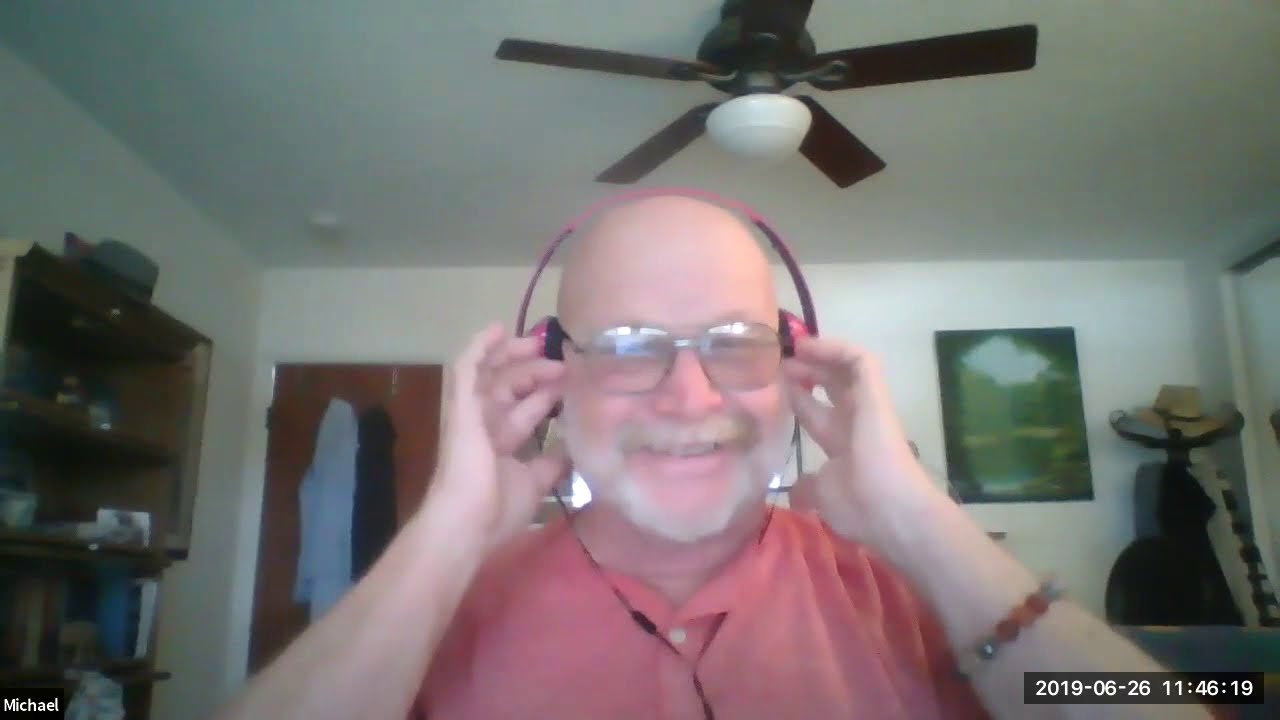
Johnny Davis guides Michael and Doug through a reading of Act 2 Scene 3 of Romeo and Juliet. This recording is the first of its kind in the Cosmos, experimenting with theater across the technical divide. Tip of the chapeau to Johnny for initiating this project!
This has been absolutely wonderful so far, and it made me really happy to watch (or at least the first eleven minutes so far that I’ve seen). I’m hoping to watch the rest when I get home. Thank you so much!
I imagine that you would be a very good Capulet! Thanks for your support, Geoffrey. And maybe we could find some time to set up a voice workshop? We could do short speeches or scenes from the plays as well as the sonnets. And other texts might be of interest. Perhaps we could rehearse some of Milton or Whitman? We could then do a podcast. Might be fun!
I’d love to do Mercutio… maybe it’s the trickster in me!
I thought of Whitman, and Shakespeare’s sonnets are also a wonderful idea. Maybe we could do a podcast focussed on reading sonnets. Between Shakespeare, Donne, Gerard Manley Hopkins, and others, it could be wonderful to listen to the different rhythms that come from these different writer’s and epochs!
Ah, Mercutio! Even better. I see queen Mab hath been with you. I love this idea. I love all the poets you mentioned. And there may be some space for some poetry reading in the Axial Age. Let’s make it happen.
I think Merlin Donald’s mimetic culture is relevant here:
Mimetic culture still forms the underpinning of human culture. It persists in numerous cultural variations in expression, body language, and expressive custom (most of which people are unaware of and cannot describe verbally), as well as in elementary craft and tool use, pantomime, dance, athletic skill, and prosodic vocalization, including group displays. The mimetic dimension of modern culture is recognizable by its primarily analog mode of imagining, which is sometimes (inappropriately) called “simulation.” This type of imagination— mimetic imagination— recreates an experience in real time. It survives in the performing arts and in the essentially theatrical nature of human relationships and living patterns. It also survives in music and visual art. Most visibly, it is the basis of role-playing, fantasy, and self- identification with various roles.
p. 58
Bellah, Robert N. & Hans Joas, (eds.) (2012) The Axial Age and its Consequences, Cambridge, Harvard University Press.
This is a marvelous quote, Doug, and thank you for making this connection. We are perhaps making the mimetic capacities active in this new cyberspace medium and this is a difference that makes a difference.
Exactly. Bringing these different rhythms into juxtaposition with one another could revitalize our culture building! Quantum voices are often together heard. Maybe a poetry lab?
And thank you, Andrew, for tuning in. And when we are giving voice to these old and new rhythms, what happens to the Influence of Anxiety?
Truly enjoyed this session, and I do
Thank you for the performances, Friar
And Romeo, and John for giving a
Faithful facilitation to the scene—
Servants of body & truth spoken on the sly!
I too felt myself in the room with you
‘Twixt Fool and Hermit scheming, knowing well
The fate of our entwingled generations;
So if someday our stars cross in a sphere
Of longing light where one doth blindly hear
Such luscious intonations of divine
Voices singing on bright beams, I’ll be there.